Ella Slammed the Force Again but Raven Was Right

The Raven sits on a frog after having rescued children from a flood.
Raven Tales are the traditional human and animal creation stories of the indigenous peoples of the Pacific Northwest Coast. They are also found among Athabaskan-speaking peoples and others. Raven stories exist in nearly all of the First Nations throughout the region just are most prominent in the tales of the Tsimshian, Tlingit and Tahltan people.
Raven and eagle are known past many different names by many unlike peoples and is an important effigy among written and exact stories. His tales are passed down through the generations of story tellers of the people and are of cultural and historical significance. Information technology'southward important to note that, from some storytellers' perspective, indigenous myths such every bit the Raven Tales, every bit opposed to tall tales and little stories for children, are not entertainment and tin can be the cultural property of the clan or individual that the story originates from. Information technology is customary that others should not tell stories that are owned by some other clan without their permission, and efforts should be taken to larn whether or non a detail story is owned earlier sharing it.[1]
While each culture's stories of the Raven are different, there are even those that share the same title; certain attributes of Raven remain the same. The Raven is always a magical creature able to take the grade of human, brute, fifty-fifty inanimate objects. He is a keeper of secrets, and a trickster often focused on satisfying his own gluttony for whatever he desires. His stories tell of how worldly things came to be or offer proposition to children on how to acquit.[two] : 394–395 Raven's creative nature shows itself through circumstance rather than intent, through the desire to satisfy his own needs, rather than whatever altruistic principles. Raven is both the protagonist among the stories of some groups, and the antagonist of others; he is a hero and an amusement.
Tales that feature the Raven equally the hero are specific to areas in the north of the continent such as northern British Columbia[three] and Alaska and their peoples,[2] : 387 such as the Tsimshian[2] : 397 and the Haida. Similar tales virtually Kutkh appear in Chukchi cultures in the n-due east of Asia and it is probable that they are influenced by Native American stories.[2] : 383–384
The Haida people credits Raven with finding the offset humans hiding in a clam shell; he brought them berries and salmon. The Sioux tell of how a white raven used to warn buffalo of approaching hunters. Eventually an angry hunter caught the bird and threw it into a fire, turning information technology black.[4] [ self-published source ]
Common features [edit]
While Raven tales tell the origins of man beings, they do not address the origins of organized society. In tales which mirror evolution and organisation of Native American societies, the hero is ofttimes humanity itself. Raven tales do non offer a detailed picture nigh the social relations and realities of life.[2] : 395–397
Traditional myths [edit]
Athabaskan [edit]
Athabaskan is the language family unit of several contiguous dialects spoken past diverse peoples in Western Canada and the American Due west. They can be farther subdivided into the Northern, Pacific Coast, and Southern Athabaskan language sub regions.
These groups lived in 1 of the three Athabaskan regions.
Cahto [edit]
The Cahto are an indigenous Californian group of Native Americans. The Cahto lived farthest south of all the Athapascans in California, occupying Cahto Valley and Long Valley, and in full general the country south of Blue Rock and betwixt the headwaters of the two chief branches of Eel River. The Cahto linguistic communication is one of four Athabaskan languages that were spoken in northwestern California. Nigh Cahto speakers were also bilingual in Northern Pomo.
Cosmos story [edit]
One version of the Raven cosmos story is that of the Cahto in California.[v] In one variant, Raven is taught by his begetter, Kit-ka'ositiyi-qa, to be a creator, simply Raven is unsatisfied with the issue. He creates the world but is unable to give it light or water. On hearing that light could be establish hidden in a far-off land, Raven decides to travel there and steal it. In the business firm of lite, he finds a young woman living with her father and plays the beginning of many tricks. He turns himself into a speck of clay, slips into her drinking water, and is swallowed. The daughter becomes significant and she gave nativity to an unusual and fussy kid who cries constantly and demands to touch 1 of the bundles which has been stored hanging from the walls. The kid is given one of the numberless to quiet him, merely when he tires of playing with it, he lets it go, and information technology floats away from him and disappears through the smoke pigsty. Once it reaches the sky the parcel comes undone and scatters stars across the sky. When the kid cries to have it back again he is given the second bundle to play with and lets information technology float away through the hole in the ceiling, thus releasing the moon. It all happens again with the third and last bundle, which flies away and becomes sunlight. After bringing light to the whole earth, he besides flies out through the smoke hole.[half-dozen] : 30
Tahltan [edit]
Locally among the Tahltan people, their community and livelihoods varied widely as they were frequently widely separated and would have to suffer varying conditions depending on their locality.[vii] In Tahltan culture it was believed that some of their ancestors had knowledge that others did not from times before a great flood.[viii] : 232 Some of these ancestors used that knowledge for the good of the people, while others used it for evil and to the disadvantage of others. Raven is considered to be the protagonist hero against these evil ancestors.[ix]
In Tahltan stories, Raven is referred to as Big-Crow (Tse'sketco or tceski'tco, "big raven" - from tceski'a, "raven").[eight] : 198
The Nascency of Raven [edit]
They merits that Big-Crow was born miraculously as the youngest of many brothers in the northern Tlingit country and was raised speaking the local linguistic communication.[8] : 198 He was separated from his father at birth and his father is never spoken of in all of their stories. Raven was born, the tertiary child of a woman whose previous ii boys were killed by her uncle. Each time the adult female gave birth, her uncle would offering to teach them to hunt once they were old enough; each time he would take them out on a canoe and play a trick on them, he would instruct the boys to sit down on the edge of the canoe, at which bespeak he would rock the canoe, forcing them to autumn into the water where he would leave them to drown.[8] : 199
Only her third child was Raven who took well to carving. Only equally he'd done twice earlier, her uncle asked if he could teach Raven how to hunt later he'd grown a few years. Several times she refused her uncle until Raven insisted that she allow him to become. And so they went out to sea and the same scenario played out. Raven fell into the water but rather than drown, he took one of the toy canoes he had carved and made it grow into a full size canoe. He went direct back to his mother and told of what his uncle had done.[8] : 200
Twice more than the uncle tried to drown Raven in the same mode but Raven outsmarted him each time until the uncle gave up and no longer took Raven hunting but would become alone.[8] : 200
As Raven grew into a homo, he met the uncle's wife where he tried to play with her. He tickled the girl and two birds flew out from under her arms, a bluish jay and a woodpecker; and the girl died. When the uncle returned from his hunt, he saw that his wife had died and he intended to impale Raven again, but this time in rage rather than trickery. Merely in one case over again, Raven escaped with his canoe carvings. But when Raven escaped this fourth dimension, he did not return habitation and his journeying began; never to return to his home.[viii] : 200
He starting off travelling by canoe along the seashore all alone but would stop whenever he came upon a village. When he met people whom he saw take advantage of others or utilize their power for evil, he would kill in his efforts to deprive them of power.[8] : 199
Raven travelled for many years along the declension of the Tlingit territory, commencement travelling south, having started in the n until he had gone so far south, beyond Tlingit territory until he reached the Mink people at which betoken he turned effectually and continued dorsum the other direction. He did this north southward, south north journey for several years. Not until his work along the coast was done, did he head inland along the Stikine River all the way to its source. He as well travelled along the Nass, Skeena, and Taku rivers and all of their many streams, never staying in 1 place for very long and never travelling far off from the water ways. Through his inland journeys he met the Kaska Dene, the Haida, and other nations to the east.[nine]
Later in life, when Raven had washed all the work he could do, he travelled back out to the coastal regions guided past the setting sun until he disappeared mysteriously. The only suggestion is that he may accept gone to live with the Kanu'gu and other ancient gods on an island far out into the ocean where they believed weather was created from.[9]
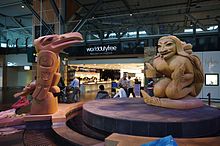
As the Raven stories continue afterwards "The Birth of Raven",[eight] : 199–200 many stories follow:
- "Origin of the Tides"[8] : 201
- "Origin of Fresh Water"[8] : 201–203
- "Origin of Olachen"[eight] : 203–204
- "Origin of Daylight"[eight] : 204
- "Raven and the Salmon"[8] : 205
- "Raven Creates the Salmon and Teaches the People"[eight] : 206
- "Raven Institutes Birth and Death"[viii] : 206
- "Raven and the Grizzly-Bear"[viii] : 208
- "Raven Paints the Bird"[8] : 208
- "Raven Paints his Men for War"[8] : 208–209
- "The Tree Eats the Bird"[eight] : 209
- "Raven Kills Pitch-Homo"[8] : 210
- "Raven and His Sister"[8] : 210
- "Raven Tries to Ally a Princess"[eight] : 210–211
- "Raven in the Country of the Tahltan"[8] : 211–212
- "Raven and Kanu'gu"[8] : 212–213
- "Raven and the Haida"[viii] : 213
- "Raven Institutes the Kuwega'n Ceremonies"[8] : 213–215
- "Raven Makes the Wolf Women Proficient-Looking"[eight] : 215–216
- "Raven Considers how to Provide for the People"[8] : 216
- "The Origin of Birth and Decease"[8] : 216
- "Raven Curtails the Powers of Game"[eight] : 216–218
- "Raven Steals Fire"[8] : 218–219
- "Raven Ballasts the Earth"[eight] : 219
- "Raven Makes Lakes"[viii] : 219–220
- "Raven Makes Mud"[viii] : 220
- "Raven Creates Carry"[eight] : 220
- "Raven and Bear-Man"[8] : 220–221
- "Raven and E'dista or Big-Toad"[viii] : 221
- "Raven and Rabbit-Human Kextsaza"[eight] : 222
- "Raven and Crow"[8] : 222–223
- "Raven and His Blanket"[viii] : 223–224
- "Raven Loses his Nose"[8] : 224–225
- "Raven and the Ghosts"[8] : 225–226
- "Raven and Porcupine Make the Seasons"[viii] : 226
Raven appears in other stories not straight related to him as well. In the story of the 'Warm and Cold Wind People' it is said that someone, possibly Raven, ordained that the people transport out the winds.[8] : 230
He appears once more in the story of "The Great Alluvion", which accounts for the killing of the evil ancestors who used their powers to have away the sun, moon, and Dipper which were lost during the flood.[8] : 234
Northern Athabaskan [edit]
- "Great Raven Makes The World"
- "Raven Steals The Low-cal"[11]
- "When Raven Was Killed"
- "How Raven Killed The Whale"
- "Raven and Mink"
- "Raven Lost His Eyes"
- "Raven and Goose-Married woman"
Inuit [edit]
The Inuit (formerly Eskimo, now a discredited term) are native to Alaska, Northern Canada and Greenland. In Inuit culture the owl, fish, and raven are of greatest prominence. Ravens are also mutual in the Inuit artwork and they have several stories that tell of Raven's birth which is often juxtaposed with the owl with whom Raven shared a deep friendship.[12] : 5
The Inuit say that Raven was born out of the darkness. He was weak and lost. As he began travelling frantically experiencing the world, he realized that he was the Raven Father, Creator of All Life. Once he realized who he was, he gathered up his strength and flew out of the darkness to a new place which he called world, but he was still alone, and then he decided to create plants. As he flew effectually exploring this new earth, he came upon a human being whom the legend claims was the first of the Inuit people. Raven fed the man and taught the man to respect the world around him. Presently afterwards, a woman came to be and Raven taught the both of them how to cloth themselves, build shelter, and make canoes to travel the water. As the two bred and spawned children, Raven cared for their children and educated them as he had done before.[13]
- "Inuit Story of Owl and Raven"
- "Raven's Bully Adventure"
- Owl Paints the Raven past Ningeokuluk Teevee[12] : 5
Aleuts [edit]
Stories from the Aleut peoples include:
- "Princess Raven"
- "Raven and His Grandmother"[15]
- "Raven's Great Take a chance"
Cup'ik (Yupik) [edit]
Raven is known every bit Tulukaruq to the Yupik peoples and is seen equally a benevolent culture hero who helps the people.[sixteen]
- "Raven Seeks A Wife"
- "Raven and Goose-Wife"
- Ellagpiim Yua
- "Raven's Daughter"
- "How The Owl Got Its Grey Spots"
Haida [edit]

The Haida people can trace their traditional territories to the Haida Gwaii archipelago in British Columbia and to the southern reaches of the Alaskan Panhandle. To the Haida, Raven was the Bringer of Light and before Raven the world was zip more a gigantic flood. Raven was the Maker of Things, likewise as the Transformer, Magician and Healer.[13] Raven was bored of the world being nothing but water and decided to fly as the waters receded. One time Raven became hungry, land was formed so he could land and find nutrient. It was at this signal he noticed strange sounds coming from a gigantic clam shell. Confused every bit to the sound, Raven decided he would begin singing to the clam beat in response to its audio, hoping to at-home it with his pleasant sounds. Raven did this considering he was a cute singer. Finally, a pocket-sized beast emerged from the clam shell. It had long black hair, a round head, brownish shine peel and two legs like Raven simply no feathers. This was the first of the First People.[17]
When he got bored with them, he considered returning them to their crush, just opted instead to notice female person counterparts of these male beings. The raven establish some female humans trapped in a chiton, freed them, and was entertained as the two sexes met and began to interact. The Raven felt responsible and very protective of them, thus many Haida myths and legends oft suggest the raven every bit a provider to mankind and combine the roles of the creator and the trickster.[18]
There are other versions that tells of a different creation. When the earth was merely heaven and water with a single reef that rose out of the water where all of the corking beings lived with the greatest of them living at the highest point on the reef and the weakest of them living at the bottom. Merely Raven flew above them all and could never find a place to land. For that reason he decided to travel to the heaven country where he met the Chief'south daughter who had recently had a child. While it was night, Raven possessed the baby and intended to take its place equally Raven Child.[thirteen]
Sun, Moon and Stars [edit]
One ancient story told on Haida Gwaii tells about how Raven helped to bring the Sun, Moon, Stars, Fresh Water, and Fire to the world:[19]
Long ago, most the beginning of the world, Grayness Eagle was the guardian of the Sun, Moon and Stars, of fresh water, and of fire. Grayness Hawkeye hated people so much that he kept these things hidden. People lived in darkness, without fire and without fresh water.
Greyness Eagle had a cute daughter, and Raven roughshod in love with her. In the beginning, Raven was a snow-white bird, and equally such, he pleased Greyness Hawkeye'south girl. She invited him to her father's longhouse.
When Raven saw the Sun, Moon and stars, and fresh h2o hanging on the sides of Eagle's lodge, he knew what he should do. He watched for his risk to seize them when no 1 was looking. He stole all of them, and a brand of burn down also, and flew out of the longhouse through the smoke hole. As before long as Raven got outside he hung the Sun up in the sky. It made so much light that he was able to fly far out to an island in the middle of the ocean. When the Sun prepare, he fastened the Moon upwardly in the sky and hung the stars around in dissimilar places. By this new low-cal he kept on flight, carrying with him the fresh water and the brand of fire he had stolen.
He flew back over the country. When he had reached the right identify, he dropped all the h2o he had stolen. It savage to the ground and in that location became the source of all the fresh-h2o streams and lakes in the world. Then Raven flew on, holding the brand of burn down in his bill. The smoke from the burn down blew back over his white feathers and made them black. When his beak began to burn, he had to drop the firebrand. It struck rocks and hid itself within them. That is why, if you strike 2 stones together, sparks of fire will drop out.
Raven'southward feathers never became white once again after they were blackened by the smoke from the firebrand. That is why Raven is now a black bird.
Other Haida stories include:
- "The Coming of the Salmon"[20]
- "The Raven and the First Men"[21]
- "The Bear and His Indian Wife"[22] : 419
Heiltsuk (Bella Bella) [edit]
The Heiltsuk were formerly known as the Bella Bella people and lived along the key coast of British Columbia. To the Bella Bella Raven was known every bit the Real Primary or He'mask.as. Raven is revered by them as a chivalrous figure. He helps people, but he is also a trickster spirit whose unreflected behaviour gets him into trouble.[23]
- "The World is Burnt"[23] Raven foretells a world fire
Kwakwakaʼwakw [edit]
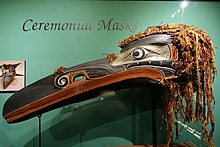
Some other story of the Kwakiutl or Kwakwakaʼwakw of British Columbia who exposed boys' placentas to ravens to encourage futurity prophetic visions, thereby associating the raven with prophecy, similar to the traditions of Scandinavia.[24]
- "Wakiash and the Offset Totem Pole"[22] : 423
Miwok [edit]
The Miwok are segregated into iii distinct groups: the Coast Miwok, the Lake Miwok, and the Plains and Sierra Miwok (Interior) which make up the bulk of the overall population.
The Miwok territory is defined past the Maidu to their right, the Yokuts to the left, and the Washoe and Mono behind them. The Interior Miwok faction live primarily on the western side of the Sierra Nevada to a higher place the lower San Joaquin Valley. The Sierra territory of the Miwok extended from the Cosumnes River on the north to the Fresno River on the south merely the other boundaries that are shared with the Yokuts, Wintun, and Maidu have always been a affair of controversy.[25] : 5
Amidst the Northern Miwok of what is now Key California the story of Raven begins with a world covered in h2o except for a unmarried mountain top where people had gathered during the flooding of the earth. As the waters receded the people tried to come down from the mountain simply the state was and then soft with mud that those that tried would sink into the ground. Wherever a person sank, a raven would come and stand on that spot. One raven at each hole. Once the ground hardened the raven turned into a person, explaining why Miwok are so dark.[26]
Nuu-chah-nulth [edit]
The Nuu-chah-nulth, who speak a southern Wakashan language known as Nuu-chah-nulth, are also known ordinarily as the Nootka.
- "Octopus and Raven"[27] : 39
Ojibwe [edit]
The Ojibwe are also known by other names including Anishinaabe which is the name of their language, Ojibwe, or Algonquin.
The Saulteaux or Plains Ojibwa, also known as Bûngi Indians, live on the Long Plains Reserve in Manitoba.[28]
- "Turtle's War-Party"[29] : 295–297
- "The Human being and the Ravens"[30] [31]
Puget Sound [edit]
Another raven story from the Puget Sound region describes the "Raven" as having originally lived in the land of spirits (literally bird land) that existed before the globe of humans. One day the Raven became and then bored with bird land that he flew away, carrying a rock in his beak. When the Raven became tired of conveying the stone and dropped information technology, the rock fell into the ocean and expanded until information technology formed the firmament on which humans now live.[32] [ self-published source ]
- "The Legend of Raven"[33]
Pima [edit]
The Pima are in Arizona.
- "The Children of Cloud"[34] : 34
Quileute [edit]
The Quileute are a Native American people in western Washington country in the The states, currently numbering approximately 2000. Their language belongs to the Chimakuan languages family unit.
The native name for Raven among the Quileute is Báyaḳ (By-yuhk).[35] : ix
Quileute Indians were the southernmost group along the Pacific Declension whose mythology included several stories of the Raven. Though the Quileute's primary protagonist was not the Raven, but Kweeti, whose stories can be very closely related to similar stories of the Tlingit involving the Raven.[35] : 6
The Raven, among the Quileute people, is used to tell scary stories to children of how Raven's anxiety : 226 [36] : 259 look the way they do; others pursued children to be generous rather than selfish, or to be true to themselves and work difficult rather than trying to take shortcuts. In their stories Raven is often punished, or must witness suffering past the people whom he cares for as a result of his trickery.[35] : iv
In the Quileute story of Duskeah[36] : 255
In the first story of "Kweeti" the story goes "At Neah Bay he taught them to fish, equally all men practise. He traversed the whole world." which is compared to the Tlingit story "Raven teaches people their mode of life".[36] : 252
Again in the story of the "Kweeti and the Wolves", "Finally, when the wolves had all but caught him, Kweeti urinated and made Ozetta Lake." which is compared to "Raven Creates Rivers".[36] : 254
But in one story, Raven and Kweeti come across and Kweed entertains Raven.[36] : 259–260
- "Báyaḳ and Ákil" (Raven and Bear)
- "Báyaḳ and Yardwestíd" (Raven and Fishduck)
- "Báyaḳ and Pákwad" (Raven and Skatefish)
- "Báyaḳ and Píxťadax" (Raven and Eagle)
- "The Bungling Host"[36] : 259–261
- "Duskeah" [36] : 255–256
- "Raven lights the world: Hungry for clams"[37]
Salishan [edit]
Coeur d'Alene [edit]
The Coeur d'Alene live in villages along the Coeur d'Alene, Saint Joe, Clark Fork and Spokane Rivers; besides every bit sites on the shores of Lake Coeur d'Alene, Lake Pend Oreille and Lake Hayden, in what is now northern Idaho, eastern Washington and western Montana.
- "Circumvoluted Raven and the Jesuits"[38] : 287
Squamish [edit]
The Squamish see Raven to be a symbol of the Creator and fifty-fifty to this 24-hour interval is the subject field of preachings.[39]
- "Raven: The Brave Warrior"
- "Raven Proposes and is Accepted"
- "Raven and the Fish Melt"
- "The Mink, the Raven and the Sea Eggs"
Shishalh [edit]
Stories from the Shishalh or Schelt include:
- "The Seal and the Raven"[38] : 200
Tlingit [edit]

Tlingit and neighbouring peoples
Tlingit territory is in Southeast Alaska.[41] Most of their territory is in nowadays-24-hour interval Canada.
The Tlingit have many names for raven, the most common being Yéil. Other names are Yéil Tl'éetl'i, g̱uneit, gidzanóox' and yéilk'. The mythological origin of his name is that he was given information technology past the tide woman. An etymological relation in Tlingit is to the verb "Yéil" which denotes trickery, lies, and mimicry.
In Tlingit culture, there are two different raven characters which can be identified, although they are not e'er clearly differentiated. Ane is the creator raven, responsible for bringing the world into existence and who is sometimes considered to be the individual who brought light to the darkness. The other is the childish raven, e'er selfish, sly, conniving, and hungry. When the Great Spirit created all things he kept them dissever and stored in cedar boxes. The Great Spirit gifted these boxes to the animals who existed earlier humans. When the animals opened the boxes all the things that comprise the world came into being. The boxes held such things equally mountains, burn, water, air current and seeds for all the plants. One such box, which was given to Seagull, contained all the calorie-free of the world. Seagull coveted his box and refused to open up it, clutching it nether his fly. All the people asked Raven to persuade Seagull to open information technology and release the low-cal. Despite begging, enervating, flattering and trying to trick him into opening the box, Seagull even so refused. Raven became angry and frustrated, and stuck a thorn in Seagull's foot. Raven pushed the thorn in deeper until the pain acquired Seagull to drib the box. Then out of the box came the sun, moon and stars that brought low-cal to the earth and allowed the beginning twenty-four hours to brainstorm.[42]
Theft of h2o [edit]
Raven connected using such trickery to bring h2o and stamp people, animals and other features in the world with certain characteristics.[43] Many versions of Raven's theft of water are told but all centre on Raven's trickery against the owner of water. In one version Raven leads its owner to believe he has soiled his bed in his sleep and threatens to shame him unless he shares his h2o with Raven. In another version Raven puts ash on his tongue to fool the possessor to believe his farthermost thirst is unquenched. Instead of drinking the h2o Raven collects it in a seal's bladder hidden nether his clothes and flees with all of information technology.[44]
Tsimshian [edit]
To the Tsimshian, Raven, was known as Txamsem or ganhada or the Clever One and was accompanied by a brother named Lagabula or Lazy One.[45]
The 2 had been born in a kelp patch and adopted by a Chief's wife and a magical being from the region of Prince Rupert Harbour. At the fourth dimension of their birth things such every bit daylight did not however exist; simply dusk. Some records contradict this stating that they were of Gispaxloats origin, born of a Gispaxloats Primary who married a beautiful princess.[46] : 86
Among their journeys, they travelled to a mountain at the caput of the Nass River. Txamsem, who could transform into anything, and often took the form of a human or bird, turned himself into a pine needle and was consumed by the daughter of the Chief who guarded daylight. She then gave nascence to him equally a babe and the babe cried incessantly to play with daylight. As soon as it was given to the baby in the grade of a playful ball, he transformed back into Raven and flew away with it. He travelled back up the Nass River with daylight and released information technology; immediately lighting upwards the river and allowing it to spread all over the world.[47] : 1
The most prominent culture hero for many of the indigenous peoples of the Pacific Northwest is Raven. There are numerous stories, widely distributed which focus on the Raven myth and his adventures to satisfy his insatiable desire to obtain whatever he wants. The plot of about Raven tales, tell of how Raven is able to use strength or trickery to obtain or motivate someone else to relinquish an object he desires. Throughout his many stories, Raven claims daylight, water, fire, the oceans waves, the olachen, salmon, the soil, and even the weather.[48] : 618
Through the Raven tales, people are able to explain why their surrounding environment was the way it was by linking the Raven or his companions equally the cause for why various things in the world come nearly.
Some stories account for the creation of dangerous animals which were transformed from inanimate objects(No 61. p 572), others suggest that men, animals and objects could be turned to stone.(nos89-93). While other stories propose how names were attributed to important landmarks, and how meaning geographical features came about.
There is a vague mention that Raven was the ancestor of the Raven Association, but at that place are no other directly references between Raven and the ancestry of the Indian people.[48] : 619
- "The Beginning"[49]
- "The Theft of Lite"
- "Raven Becomes Voracious"[6] : 19 [fifty]
- Origin of Txa'msem [48] : 58
- Origin of daylight[48] : 60
- Rock and Elderberry Bush[48] : 62
- Origin of fire[48] : 63
- Txa'msem uses the sinews of the tomtit[48] : 63
- Origin of tides[48] : 64
- Giant gambles with Dupe[48] : 65
- Giant obtains the olachen[48]
- Giant learns how to melt olachen[48] : 66
- Giant and the gulls[48] : 66
- Txa'msem and the steelhead-salmon[48] : 67
- Txa'msem and Lagobola'[48] : 68
- Txa'msem and the crab[48] : seventy
- Origin of the bullhead[48] : 71
- Txa'msem frightens abroad the owners of a whale[48] : 71
- Txa'msem finds a cute blanket[48] : 72
- Txa'msem and his slave[48] : 73
- Txa'msem kills his slave[48] : 74
- Fishermen break off Txa'msem jaw[48] : 74
- Txa'msem and the Hunter[48] : 75
- Txa'msem and the children[48] : 75
- Txa'msem and the salmon woman[48] : 76
- Txa'msem makes war on the southward wind[48] : 79
- Txa'msem makes a girl sick and and then cures her[48] : 81
- Txa'msem pretends to build a canoe[48] : 84
- Txa'msem visits Main Repeat[48] : 85
- Txa'msem kills Picayune Pitch[48] : 86
- Txa'msem kills Grizzly Behave[48] : 87
- Txa'msem kills Deer[48] : 88
- Txa'msem imitates Chief Seal[48] : 90
- Txa'msem imitates Master Kingfisher[48] : 91
- Txa'msem imitates the thrush[48] : 91
- Txa'msem and Cormorant[48] : 92
- Txa'msem returns to the Wolves[48] : 94
- Txa'msem invites the monsters[48] : 100
- The further history of Txa'msem [48] : 100
- Txa'msem invites the monsters[48] : 100
- The further history of Txa'msem [48] : 100
- Raven obtains fresh h2o[48] : 651
- Raven paints the birds[48] : 664
- Raven carves salmon out of diverse kinds of wood[48] : 666
- Raven marries the dead twin[48] : 667
- Raven abducts the daughter of the salmon chief[48] : 671
- Raven gets the soil[48] : 674
- Why Crow and Raven are black[48] : 677
- Raven and Eagle get together red and black cod[48] : 692
- Raven marries Hair-Seal-Woman[48] : 702
- Raven steals salmon eggs[48] : 705
- Raven steals his sisters' berries[48] : 705
- Raven'south gizzard is torn out[48] : 706
- Raven kills the seals[48] : 706
- Raven pretends to be dead[48] : 706
- Raven burns his sister's groins[48] : 707
- Raven deserts Master Fisherman on a lonely island[48] : 710
- War with the Thunderbird[48] : 711
- Wren kills the Bear[48] : 718
- Raven pulls off the arm of a chief[48] : 719
- Raven is set afloat[48] : 720
Zuni [edit]

The Coyote canoeing upwardly Columbia River. The Raven shares the trickster nature with the coyote in Native American mythologies, but for the Zuni people he lacks the negative characteristics.
The raven is not a traditional fetish of the Zuni but he, along with the Macaw play a office in the Zuni story of migration and is carved often in their artwork, typically carved from black marble though non exclusively.
The Zuni consider Raven to be a prankster simply without negative characteristics which they acquaintance with the coyote. The Raven's greatest traits are his ability to assist the people in overcoming their failures by offering gentle reminders that anything people accept the courage to face, thus too do they have the power to transform.[51]
- "Origin of Raven and the Macaw"[34] : xl
- "The Search for the Corn Maidens"[34] : twoscore
Modern adaptations [edit]
In that location have been many children'south and pic books that recount traditional Raven Tales. These new versions have been criticized for portraying a much "nicer" Raven with little left from the original greedy trickster. In some stories Raven acts for the skilful of people and non for himself. In other stories Raven refuses to utilise strength, and sexual themes are edited out. Trickery is in some instances substituted for magic. These newer tales are likewise written in conventions of Western rather than Native American literature thus conveying the message that native storytellers' ability or way is inferior.[53]
In 2004, The Smithsonian Institution sponsored Chris Kientz to develop a series of half-hour animated television programs targeted at school children as an entertaining way of educating kids on aboriginal folklore. The show Raven Tales was produced by New Machine Studios working with producer Winadzi James and aired for 2 seasons with a total of 26 episodes.[54] [55]
In 2010, Matt Dembicki produced an anthological graphic novel of the trickster stories, making sure to maintain the cultural integrity of the stories with the help of 21 Native American story-tellers who were paired directly with several graphic designers.[56]
See likewise [edit]
- Ethnic peoples in Canada
- Alaska Native storytelling
- Cultural depictions of ravens
- History of the west coast of N America
- Northwest Coast art
- The Raven – a German fairy tale nerveless by the Brothers Grimm
- The Seven Ravens – a German fairy tale collected by the Brothers Grimm
- Thunderbird (mythology)
References [edit]
- ^ Giese, Paula (1996). "Who Owns the Stories — A Alphabetic character to Eldrbarry". Retrieved ane September 2014.
- ^ a b c d e Boas, Franz (October–December 1914). "Mythology and Folk-Tales of the N American Indians". The Journal of American Folklore. 27 (106): 374–410. doi:10.2307/534740. JSTOR 534740.
- ^ Kuiper, Kathleen (2011). Native American Civilization. The Rosen Publishing Group. p. 58. ISBN978-1615301386.
- ^ Nyxks (27 November 2000). "How The Raven Became Black". Archived from the original on 10 September 2014. Retrieved 8 September 2014.
- ^ Goddard, Pliny Earle (1909). "Kato texts". eight (3): 184. Retrieved 24 August 2012.
- ^ a b Thompson, Stith (1929). "1 Mythological Stories" (PDF). Tales of the North American Indians (3rd pr. ed.). Cambridge, Mass.: Harvard University Press. ISBN978-0253200914. Archived from the original (PDF) on 28 May 2015. Retrieved three September 2014.
- ^ editor, William C. Sturtevant, general (1978). Handbook of N American Indians. Washington: Smithsonian Institution. p. 463. ISBN9780160045783 . Retrieved iii September 2014.
- ^ a b c d e f thousand h i j chiliad l m n o p q r south t u v w 10 y z aa ab ac advertisement ae af ag ah ai aj ak al am an ao ap aq ar as at Teit, James A (1920). Boas, Franz (ed.). "Tahltan Tales". The Journal of American Folk-Lore. 32 (124): 198–250. doi:10.2307/534980. JSTOR 534980.
- ^ a b c "The Raven wheel". SAMS Anthology. Archived from the original on iii September 2014. Retrieved iii September 2014.
- ^ "Raven's Athabaskan Tales". Retrieved 5 September 2014.
- ^ a b Skinner, Kelly; Brill, Laura. "Inuit Views of Nature" (PDF). St. Lawrence University.
- ^ a b c "The Story of the Raven". Raven Eco Ventures. 2004. Archived from the original on 22 December 2014. Retrieved iv September 2014.
- ^ "Raven and His Grandmother". Retrieved five September 2014.
- ^ "Yupik Legends". Retrieved 5 September 2014.
- ^ Carolyn, Kenny (June 1994). Connections: Integrating our Piece of work and play (Dr.) (Keynote presentation). Our Legacy: Work and Play. Vol. 4. Annual briefing of the American Association for Music Therapy. Retrieved 4 September 2014. [ permanent dead link ]
- ^ Svitko, Darren A.; Rosado, Jessica A. "Raven Cosmos". Prezi Inc. Retrieved 8 September 2014.
- ^ Clark, Ella E.: Indian Legends of the Pacific Northwest, University of California Press, 1953.
- ^ "Native American Legends" (PDF). The states Forest Service, The states: three.
- ^ "First Nations in British Columbia: An Exploration of Cultural Continuity and Alter" (PDF). Education Plan (Grades 8 to 12). UBC: Museum of Anthropology. 2003: eight. Retrieved v September 2014.
- ^ a b Ortiz, selected and edited by Richard Erdoes and Alfonso (1985). American Indian myths and legends (PDF) ([second impr.]. ed.). New York: Pantheon Books/Random Business firm. ISBN978-0-394-74018-viii. Archived from the original (PDF) on 17 Dec 2014. Retrieved 5 September 2014.
- ^ a b "Heiltsuk/Bella Bella Legends, Myths, and Stories". 1998. Retrieved 5 September 2014.
- ^ Cribley, Byron. "Reproductive Physiology Lecture Notes" (PDF). Buchanan, MI 49107: Buchanan High Schoolhouse: 310. Archived from the original (PDF) on iii September 2014. Retrieved 2 September 2014. CS1 maint: location (link)
- ^ Kroeber, A.L. (1919). "Geography" (PDF). Handbook of the Indians of California ([Nachdr.] ed.). New York: Dover Publications. ISBN9780486233680 . Retrieved five September 2014.
- ^ Hart, Merriam C (1910). "The Dawn of the World". University of Nebraska Press. OCLC 2581152. Retrieved 30 August 2007.
- ^ Deloria, told by Joseph Bruchac ; foreword by Vine; Fadden, Jr. ; illustrations past John Kahionhes; Fadden, David Kanietakeron (1992). Native American animal stories. Gilded, Colo.: Fulcrum Pub. ISBN9781555911270.
- ^ Skinner, Alanson (April–June 1914). "The Cultural Positions of the Plains Ojibway". American Anthropologist. New Serial. 16 (2): 314–318. doi:10.1525/aa.1914.16.2.02a00090. JSTOR 659613.
- ^ Skinner, Alanson (1920). Boas, Franz (ed.). "Plains Ojibwa Tales". The Periodical of American Folk-Lore. 32 (124): 280–305. doi:10.2307/534982. JSTOR 534982.
- ^ "The Man and the Ravens". Retrieved 5 September 2014.
- ^ White, Charles Phillip (fifteen August 1995). "The Human and the Ravens". Retrieved 5 September 2014.
- ^ John (26 Nov 2011). "The raven tattoo on my correct leg". Archived from the original on ten September 2014. Retrieved 8 September 2014.
A raven story from the Puget Audio region describes the "Raven" as having originally lived in the country of spirits (literally bird state)
- ^ "Raven Stories" (PDF). Muncie, IN: Brawl State University. Archived from the original (PDF) on 27 November 2014. Retrieved five September 2014.
- ^ a b c Judson, Katharine Drupe (1912). Myths and Legends of California and the Old Southwest (TXT) (2nd ed.). Chicago: A.C. McClurg & Co. Retrieved 5 September 2014.
- ^ a b c Woodruff, Sr, Fred. Jensen, Vickie; Powell, Jay (eds.). "Raven Tales:Traditional Quileute Stories of Bayak, the Trickster" (PDF). Quileute River Classroom. La Push, Washington: Quileute Tribal School of the Quileute Nation. Archived from the original (PDF) on 24 September 2015. Retrieved 3 September 2014.
- ^ a b c d e f g Farrand, Livingston; Mayer, Theresa (1920). Boas, Franz (ed.). "The Journal of American Folk-Lore". The Journal of American Folklore. 32 (124): 251. doi:10.2307/534981. JSTOR 534981.
- ^ Ortiz, selected and edited by Richard Erdoes and Alfonso (1998). American Indian trickster tales . New York: Penguin Books. ISBN978-0-670-87829-1 . Retrieved 5 September 2014.
- ^ a b Thompson, edited by 1000. Terry; Egesdal, Steven One thousand. (2008). Salish myths and legends : one people's stories (PDF). Lincoln: University of Nebraska Press. ISBN9780803210899 . Retrieved 5 September 2014.
- ^ "God Outside the Lines" (PDF). Squamish United Church. 28 July 2013. p. i. Archived from the original (PDF) on five September 2014. Retrieved five September 2014.
(2nd Paragraph) Why not call back of the Holy Spirit equally the legendary Raven, the Trickster, who is always surprising u.s.a., turning things upside downwardly, helping us to run across in new ways. ..(Last paragraph, page 1) information technology has encouraged my home congregation ... to portray the Spirit as a slap-up blue heron.
- ^ "The Raven Story". Retrieved iii September 2014.
- ^ Swanton, John (1909). "Tlingit Myths and Texts" (PDF). Smithsonian Establishment. Agency of American Ethnology. Bulletin (39). Retrieved 3 September 2014.
- ^ Leeming, David A. (2009). "Creation Myths of the World: An Encyclopedia" (PDF). Cosmos Myths of the World (2d ed.). Greenwood Publishing Group. pp. 260, 343. ISBN978-one-59884-174-ix.
- ^ "Bulletin". Agency of American Ethnology. p. 72. Archived from the original on iv September 2014. Retrieved iii September 2014.
Emmons also published petro-glyphs on Lisiansky Bay, Baranof Island, where the totemic crests are organized to illustrate the Raven myth of the theft of water
- ^ Turner, Nancy J. (2014). Ancient pathways, bequeathed knowledge : ethnobotany and ecological wisdom of Indigenous peoples of northwestern N America. pp. 256, 259, 263, 273–278, 286, 288. ISBN9780773585409.
- ^ Ayaawx (Ts'msyen ancestral law): The power of Transformation (PDF) (Doctorate of Philosophy). University of Victoria. 1993.
- ^ Barbeau, Marius; Beynon, William (1987). Cove, John J.; MacDonald, George F. (eds.). Tsimshian narratives. Ottawa: Advisers, Canadian Museum of Civilization. ISBN978-0660107615.
- ^ a b c d due east f g h i j g l thousand n o p q r s t u v w 10 y z aa ab ac advertizing ae af ag ah ai aj ak al am an ao ap aq ar as at au av aw ax ay az ba bb bc bd be bf bg bh Boas, Franz; Tate, Henry West. (1916). "Tsimshian mythology". Annual report of the Bureau of American Ethnology (1). Smithsonian Institution Bureau of American Ethnology. Retrieved 3 September 2014.
- ^ McEntee, retold by Fran Martin ; pictures by Dorothy (1975). Raven-who-sets-things-correct : Indian tales of the Northwest coast (Rev. ed., with all new art, of Nine tales of raven. ed.). New York: Harper & Row. ISBN978-0060240714 . Retrieved i September 2014.
- ^ Boas, Franz (1902). Tsimshian Texts. Washington : Govt. impress. off. ISBN978-1141405503.
- ^ Riggs, Darlene Meader (2006). "Zuni Fetish Meanings". The Zuni Fetish Story.
- ^ Singer, Eliot A. "Fakelore, Multiculturalism, and the Ethics of Children's Literature".
- ^ "The Award-Winning Blithe Series". RavenTales (Alberta) Ltd. 2004. Retrieved i September 2014.
- ^ "Raven Tales Episode Guide". Smithsonian Channel. SNI/SI Networks L.L.C. Archived from the original on 3 September 2014. Retrieved 1 September 2014.
- ^ Higgins, Jim. "'Trickster Tales': Gladstone, Indian storytellers team with artists". Milwaukee Journal Picket . Retrieved ane September 2014.
Farther reading [edit]
- Greene, Diana Scesny; Paul, Louise; Malcolm, Eliza (1988). Raven tales & medicine men : folktales from Eagle Village. Eagle Village: publisher not identified. OCLC 18392019.
- Goodchild, Peter (1991). Raven tales. Chicago: Chicago Review Press. ISBN9781556521010. OCLC 22907395.
- Liapunova, R. G. (1987). "Raven in the Folklore and Mythology of the Aleuts". In: Soviet Anthropology and Archeology, 26:1, 3-20. doi:10.2753/AAE1061-195926013.
- Meletinsky, Elizar M. "The Epic of the Raven Among the Paleoasiatics: Relations Between Northern Asia and Northwest America in Sociology". In: Diogenes 28 (110): 98-133 (1980). DOI: 10.1177/039219218002811006
- Reid, Pecker; Bringhurst, Robert (1996). The raven steals the calorie-free: Native American tales. Boston: Shambhala. ISBN9781570621734. OCLC 32819116.
External links [edit]
- Journal of Surrealism and the Americas Vol 6, No. 1, Pages 39-60 'What Makes Indians Laugh' Claudia Mesch, Arizona Country University
- List of Indian Tales by Region
- Bill Reid, storyteller: "The Raven steals the light"
- Map of North-Western Regional Indian Territories
- Raven Tales at IMDb
- (in German) Isabel Budke: Raven Travelling. Schöpfungsmythos, 1996
bernsteinwitheauted.blogspot.com
Source: https://en.wikipedia.org/wiki/Raven_Tales
0 Response to "Ella Slammed the Force Again but Raven Was Right"
Post a Comment